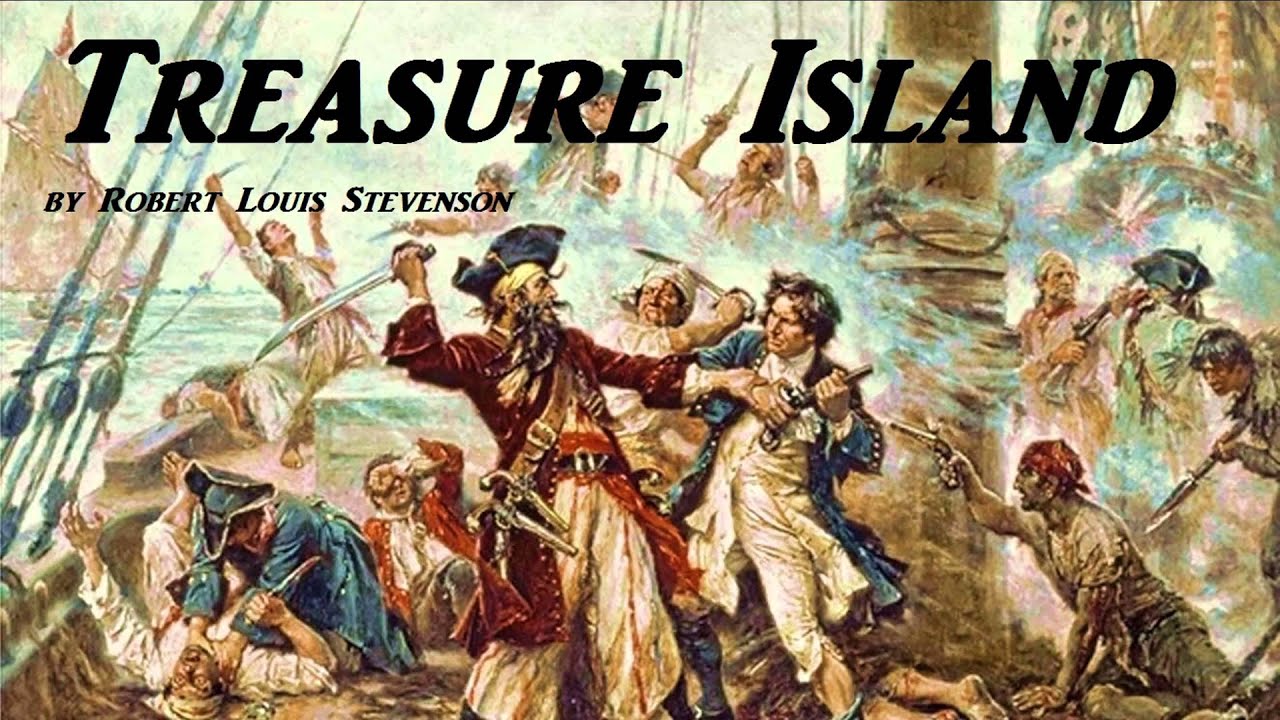
Treasure Island made its debut into the literary world in 1881, like so many other Victorian novels, as a serial. Its original title was The Sea Cook under the pseudonym Captain George North. The title was changed at the suggestion of a friend to Treasure Island; or the Mutiny of the Hispaniola (Pierce 361). It was surprisingly unpopular in Young Folks, but when it came out published in novel form, it had a vast appeal. This post gives a brief overview of Treasure Island's beginnings.
Both the creation and subject matter of Robert Louis Stevenson's Treasure Island place it firmly in the nineteenth-century romantic genre. While sketching with his stepson Lloyd on a dark and stormy night, Stevenson drew up a map of an island. As he looked at his handiwork, he immediately received the inspiration of the beginnings of an adventure story filled with pirates, parrots, and buried treasure. He wrote at the speed of one chapter a day for the next fifteen days, reading his accomplishments out loud to his stepson and family at the end of each day. After weeks of writer’s block, the second half of the novel was not finished until later when Stevenson took his family to the Swiss Alps, hoping the change in climate would help his health. He was correct, and once he sat down, the rest of the novel flowed easily again at the pace of a chapter a day until it was finished (Cordingly).
Everyone was delighted with the story, especially Lloyd. Stevenson deliberately wrote it as an adventure story for young boys though he had never before written anything for children previously (Mann 180). It was published serially at first in Young Folks magazine. Each week from October 1881—January 1882, the magazine published a chapter. Though it received a lukewarm reception in magazine circulation, when it was bound and published as a novel 1883, it took on a much larger readership and immediately enchanted the public.
Daniel Defoe’s Robinson Crusoe introduced adventure romance stories for boys a century and a half earlier than Treasure Island, which was so popular that it never went out of print since its publication in 1719 (Blake 165). This provided a generative and popular framework of pirates, desert islands, and adventure that Stevenson built from and changed. Though there was a culture of male-dominated pirate and tropical island adventure stories, much of the imagery associated with pirates from the nineteenth century and into pop culture today comes from Stevenson’s Treasure Island including buried treasure, shoulder-parrots, pieces of eight, marooned sailors, and treasure maps (Cordingly xiv). As his novel became so immensely popular, Stevenson changed the existing culture and imaginative imagery around pirates that has perpetuated into modern imaginative consciousness.

Stevenson was known as a writer before this time, but he was not making enough to subsist as a writer with his previous works. Treasure Island was his first completed novel, and the work that was most successful up until that point and allowed him to make a living writing. Stevenson says of his time writing before Treasure Island, “By that time I had written little books and little essays and short stories, and had got patted on the back and paid tor them—though not enough to live upon” (Stevenson 189). He was quite intimidated at the prospect of writing a novel. He says, "Anybody can write a short story--a bad one I mean--who has industry and paper and time enough; but not everyone may hope to write even a bad novel" (189). He saw it as a mighty endeavor where all the stars must align to even begin, but he persevered and gained a reputation of which Arthur Conan Doyle would say “Stevenson can claim to have mastered the whole gamut of fiction…No man has more marked individuality, and yet no man effaces himself more completely when he sets himself to tell a tale” (Cordingly viii). Biographer David Daiches said “Stevenson produced some of the most memorable fiction in our language….He transformed the Victorian boys’ adventure into a classic of its kind” (viii). Stevenson took the conventions already in place and changed and surpassed them (Mann 181), changing the genre of romantic, adventure, and boys' fiction in the late nineteenth century.
